Warehouse Jobs in the USA: Shifts, Pay and Applications
Warehouse jobs draw about 201,000 searches a month in the US — but only 2 roles on GigBlow carry "warehouse" in the title right now. This guide shows the two live roles, the shifts employers run, what the work pays, and how to find the rest.
Key takeaways
- Warehouse jobs in the USA are hired mostly by title, not by a warehouse category — only 2 roles on GigBlow carry "warehouse" in the title right now.
- The work is shift work: first, second and third shifts, plus weekend rosters, and the shift shapes the pay and the lifestyle.
- The national median for the work is $19.35 an hour (BLS, May 2024) — check the listing, because pay varies by employer, state and shift.
- Search "warehouse jobs near me" and "warehouse jobs hiring near me", then read the advert for the shift and the physical requirements before you apply.
In this guide
- The honest numbers behind warehouse jobs in the USA
- What warehouse work actually involves
- Warehouse shifts compared
- What warehouse jobs pay
- A real pay example: two live warehouse roles on GigBlow
- Amazon Warehouse Jobs
- How to find warehouse jobs hiring near you
- What employers ask for, and what they do not
- How to apply on GigBlow
- Frequently asked questions
Warehouse jobs are one of the most searched-for kinds of work in the United States — "warehouse jobs" draws about 201,000 searches a month in the US, and "warehouse jobs near me" about the same again — because the work is straightforward to start, it hires all year, and it rarely asks for a degree. GigBlow currently lists 187,009 live jobs across the United States, the United Kingdom and Canada — 52,302 in the USA, 85,008 in the UK and 49,699 in Canada — and this guide is about the American end of that board: what warehouse work actually involves, which shifts employers run, what it pays, and how to apply.
Here is the honest picture first, because it shapes everything else in this guide. Only 2 roles on GigBlow in the USA carry the word "warehouse" in the job title right now, both from Company B (WhatJobs) and CompanyG A (JobG8) — the only two sources this guide uses. Another 78 live USA listings mention warehouse work in the description, and the Logistics & Transport category holds 153 USA roles. That is a thin live list for a job title that gets 201,000 searches a month, and it tells you something useful: on GigBlow, warehouse work is usually advertised by its specific role — picker, packer, forklift operator, material handler, shipping clerk — rather than under the single word "warehouse". If you search only for "warehouse", you will miss most of the work. This guide shows you the two live warehouse-titled roles, then teaches you how to find the rest.
The honest numbers behind warehouse jobs in the USA
The two live warehouse-titled roles are both the same posting in two Florida locations: a Warehouse Clerk on the 2nd shift, advertised by Alliance Workforce in Saint Petersburg and in Largo, Florida. Both are genuine, live, and open to apply for today. Everything else in this guide is built around them and around the wider set of roles that do the same work under different titles.
The wider set is where the volume sits. Seventy-eight live USA listings mention warehouse work in the description, and the Logistics & Transport category — the closest thing to a warehouse category on the board — holds 153 USA roles. The rest of the USA board is dominated by healthcare (37,946 roles), IT and software (8,392) and accounting and finance (2,732), which is why a warehouse search returns so little: GigBlow's American listings come mostly from healthcare and technology employers, and warehouse hiring comes through staffing agencies and logistics employers in smaller numbers.
That does not make warehouse work rare in the United States. Nationally, the Bureau of Labor Statistics counts about 2.95 million people employed as laborers and freight, stock, and material movers, hand — the occupation that covers most warehouse floor work. The work exists at scale; it is simply spread across many employers, many of them small, and advertised under many different titles. The search method in this guide is how you find it.
What warehouse work actually involves
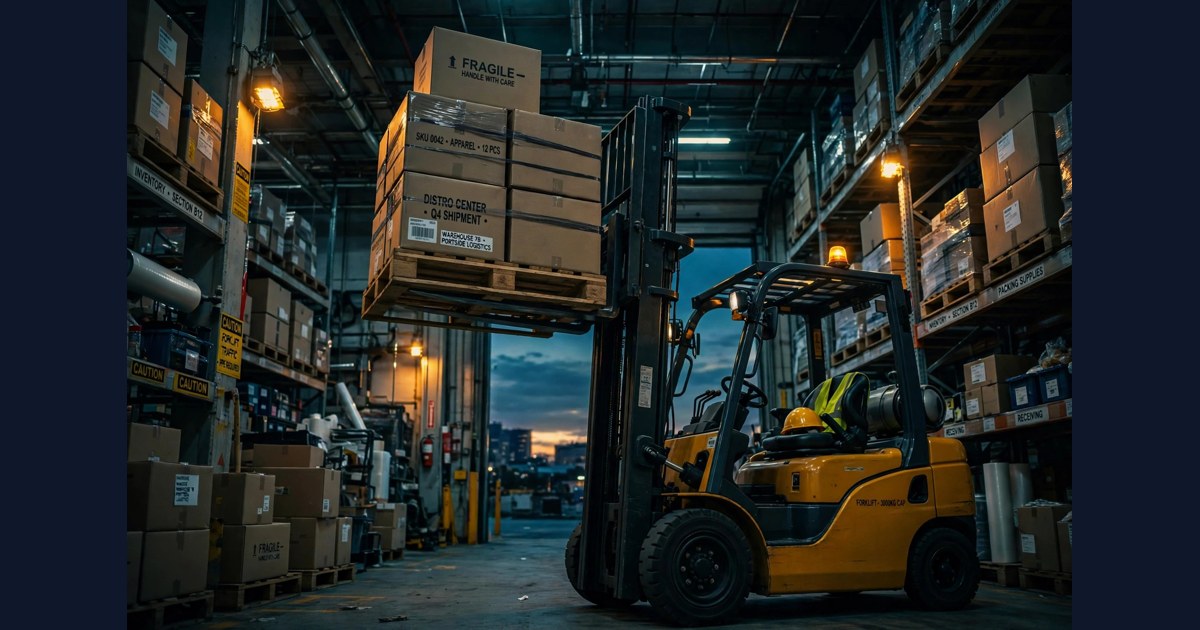
A warehouse job is physical, practical work in a distribution centre, fulfilment centre or storage facility. The exact duties depend on the building and the employer, but the core tasks repeat across almost every warehouse in the country.
Receiving. Goods arrive by truck, are checked against the delivery note, counted, and put away in the right location. A receiving role needs care with numbers and a willingness to work around vehicles and loading bays.
Picking and packing. Orders come in, and a picker collects the items from the shelves — often following a handheld scanner that tells them exactly where to go — and a packer boxes them, labels them and sends them to despatch. Picking and packing is the most common warehouse work, and it is usually measured: items picked per hour, accuracy, and orders completed. If you have seen a listing for a picker, a packer, an order picker or a fulfilment associate, it is this work.
Loading and unloading. Trucks are loaded and unloaded by hand, by pallet jack or by forklift. This is the heaviest part of the work and the part where a forklift licence matters most.
Inventory and stock control. Counting stock, checking locations, reporting damage or shortages, and keeping the shelves in order. Larger warehouses have dedicated inventory roles; smaller ones fold it into the general warehouse job.
Shipping and despatch. Labelling, weighing, checking paperwork and loading the outgoing vehicles. A shipping clerk does more paperwork and computer work than a picker, and usually needs basic computer skills.
Most warehouse roles combine several of these. A job titled "Warehouse Clerk" — like the two live roles on GigBlow — usually leans towards the paperwork and computer side: receiving goods into the system, printing labels, checking orders, and keeping records. A job titled "Warehouse Associate" usually leans towards the physical side: picking, packing and moving stock. Read the description, not just the title, because two jobs with the same title can be very different work.
Warehouse shifts compared
Warehouse work is shift work, and the shift is often more important than the job title. Most warehouses run around the clock, or close to it, and the same role can feel like a different job on a different shift. The table below compares the patterns you will see in American warehouse adverts.
| Shift | Usual hours | What it suits | What to watch for |
|---|---|---|---|
| First shift (day) | Roughly 6am–2pm or 8am–4pm | People who want evenings free; parents on the school run; anyone new to warehouse work | The most applied-for shift, so the most competition |
| Second shift (afternoon/evening) | Roughly 2pm–10pm or 4pm–midnight | People who sleep late or study in the morning; a second income alongside a day job | Evenings are gone; public transport may be thin late at night |
| Third shift (overnight) | Roughly 10pm–6am or midnight–8am | Night owls; people who want the quietest, least supervised shift | Sleep, health and safety all need managing; check the transport home |
| Weekend roster | Saturday and Sunday, or a rotating weekend | Students and people with a weekday job; part-time warehouse work | Often the same hourly rate as weekdays — check whether a weekend premium is offered |
| Rotating shifts | A pattern that changes week to week | People who want variety and are happy to adapt | Hard to plan childcare or study around; ask for the rota before you accept |
The two live Warehouse Clerk roles on GigBlow are both 2nd shift — afternoon and evening work in Florida. That is a useful detail, because a 2nd-shift role suits someone who is free in the afternoons and evenings but not in the mornings, and it is the shift most often offered to new starters: the day shift is usually held by the longest-serving staff.
Two questions to ask about any shift before you apply. First, is the shift fixed or rotating? A fixed 2nd shift is easy to plan around; a rotating pattern that moves between days and nights is much harder. Second, what happens at the edges of the shift? Warehouses run on tight schedules, and a shift that ends at midnight is only useful if you can get home afterwards — check the bus times, not just the job advert.
What warehouse jobs pay
Pay is where this guide has to be careful, because warehouse listings often do not state a rate at all. The two live Warehouse Clerk roles on GigBlow do not state pay in their listings, and this guide does not invent a figure for them. What can be stated with confidence is the national picture from the US Bureau of Labor Statistics.
The BLS Occupational Employment and Wage Statistics, May 2024, puts the median hourly wage for laborers and freight, stock, and material movers, hand at $19.35 an hour, or $40,240 a year. That is the median — half of the people in the occupation earn more, half earn less — across the whole country and all industries. It is the best single number for what warehouse floor work pays in the United States, and it is the figure to compare any offer against.
Three things move pay above or below that median. Place matters: the same work pays more in high-cost cities and less in lower-cost areas, and the BLS publishes state-level figures for exactly this reason. Shift matters: night and weekend work often carries a premium, though the amount varies by employer and is stated in the listing when it exists — never assume a premium that is not written down. Skill matters: a forklift licence, a commercial driving licence, or experience with warehouse management systems all push pay up, because they let you do work other applicants cannot.
Do not accept a rate below the legal minimum for your state, and remember that several states and cities set minimums above the federal $7.25 an hour. Check the rate for the state the warehouse is in before you apply, and divide any weekly or monthly figure by the hours you will actually work — including unpaid breaks — to get the real hourly rate.
A real pay example: two live warehouse roles on GigBlow
The best way to understand warehouse work in the USA is to look at the real roles that are live right now. The two roles below are both live on GigBlow at the time of writing, both from Company B (WhatJobs), both titled Warehouse Clerk on the 2nd shift, and both advertised by the same employer, Alliance Workforce. Their listings carry no pay information, so this guide quotes none for them — every pay figure below comes from the BLS, not from a listing.
The first is in Saint Petersburg, Florida, and the second in Largo, Florida — two towns on the same stretch of the Florida Gulf Coast, a short drive apart. Both are 2nd-shift clerk roles, which means afternoon and evening work, and both sit in the logistics corridor around Tampa Bay, where warehouses serve the retail and distribution businesses of the whole region. A clerk role here is the paperwork end of warehouse work: receiving goods into the system, checking orders, printing labels and keeping records straight, rather than the heaviest lifting. Neither listing states a rate, so neither rate appears here — this guide reports pay only where a named source publishes it.
The lesson from these two roles is narrow but useful. Warehouse hiring in Florida's Gulf Coast is happening through staffing agencies — Alliance Workforce is a staffing firm, not the warehouse operator — and it is happening on the 2nd shift. If you are looking for warehouse work in Florida, search for the staffing agencies as well as the warehouses themselves, and be ready for afternoon and evening hours. If you are looking elsewhere in the country, the same pattern usually holds: the agencies hold a large share of the warehouse roles, and the shift is the detail that decides whether the job fits your life.
Beyond these two roles, search for the work under its other names. A search for "warehouse jobs near me" will find some of it, but a search for picker, packer, forklift operator, material handler or shipping clerk will find far more — and the Logistics & Transport category on GigBlow, with 153 live USA roles, is the closest thing to a warehouse category the board has. The jobs in Florida page shows everything live in the state, including the two clerk roles, if you want to see them in context.
Amazon Warehouse Jobs
Amazon is the first name most people think of for warehouse work in the USA — and it is the largest single employer name on GigBlow’s American board, with 1,185 live USA roles. But only one of those roles carries “warehouse” in the title right now: Warehouse Clerk in Sparks, Nevada, advertised by Amazon.com. Across the whole USA board, only three roles carry “warehouse” in the title at all.
That is the honest picture: Amazon’s USA roles carry many different titles, and the “warehouse” label is rare. If you want Amazon warehouse work, search for the employer name as well as the job title — and read the listing for the shift and the location before you apply. The Sparks listing states no pay, so none is quoted here.
How to find warehouse jobs hiring near you
Most warehouse hiring is local — the warehouse is a building, and you have to be able to get to it for every shift — so the search is a local search. Work through the checklist below, which is built around the phrases people actually search for.
- Start with "warehouse jobs near me". It is the most searched warehouse phrase in the country, and it returns the roles closest to where you are. Run it on GigBlow as well as on the general search engines, because the results differ.
- Then search "warehouse jobs hiring near me". The word "hiring" filters towards roles that are open right now rather than pages that merely describe warehouse work.
- Search by the specific role, not just the word "warehouse". Try picker, packer, forklift operator, material handler, order picker, shipping clerk and fulfilment associate — each one finds roles the generic search misses.
- Search the staffing agencies directly. A large share of warehouse hiring goes through agencies like the one advertising the two live roles on GigBlow. Find the agencies in your city and check their own boards as well as GigBlow.
- Check the shift before you fall for the job. A role that fits your skills but runs on a shift you cannot work is not a real option. Filter by shift in the advert, and ask the recruiter if the shift is fixed or rotating.
- Read the physical requirements honestly. Warehouse work involves standing, walking, lifting and bending for a whole shift. If a listing states a lifting requirement, believe it — it is there because the work demands it.
- Apply the same day. Warehouse roles are often filled within days, not weeks, and the employers who hire fastest are the ones with the most roles. A good application today beats a perfect application next week.
What employers ask for, and what they do not
Warehouse work is one of the most open kinds of work in the United States for people without a degree or without much experience. Most entry-level warehouse roles ask for a high-school diploma or equivalent, the legal right to work in the US, and the physical ability to do the job. Previous warehouse experience helps, but it is often listed as "preferred" rather than "required" — and many employers train new starters on the job.
Three things genuinely improve your chances. A forklift licence is the single most useful certificate in warehouse work: it qualifies you for the best-paid floor roles and it is a skill employers can verify in a minute. Reliability matters more than a polished CV: warehouses run on rosters, and a person who turns up on time every shift is worth more than a person with a better CV who does not. And basic computer skills — a handheld scanner, a stock system, a label printer — are now part of most warehouse jobs, including clerk roles like the two live ones on GigBlow.
What employers do not ask for is a degree, a long work history, or a particular background. If a warehouse advert asks for a fee, a payment for training, or a payment for a uniform before you start, treat it as a warning sign: legitimate employers do not charge you to get the job. The guide to spotting a genuine job advert explains the checks that apply on both sides of the Atlantic, and they are worth running on any warehouse role that asks for money up front.
How to apply on GigBlow
Applying for warehouse work through GigBlow follows the same steps as any other application, with one addition: check the shift and the location before you apply, because a warehouse role is only useful if you can get there for every shift.
- Start with the USA listings. Browse jobs in the United States to see what is live across the country, then narrow by state — jobs in Florida, jobs in Texas and jobs in California are the three biggest state pages on the board.
- Search by role, not just by "warehouse". Use the search box for picker, packer, forklift operator, material handler and shipping clerk, and check the Logistics & Transport category for the wider set of roles.
- Read the whole advert before you apply. Note the employer, the location, the shift and the physical requirements. If the pay is not stated, note that too — and compare any offer you receive with the $19.35-an-hour national median from the BLS.
- Keep your application short and honest. Warehouse employers want to know that you can do the physical work, that you can work the shift, and that you will turn up. Say so plainly, and mention a forklift licence or any warehouse experience first if you have it.
- Prepare for a video interview. Many warehouse employers now interview by video, including for floor roles, and the guide to preparing for a video interview covers the technology check, the room, and the questions you will be asked.
Frequently asked questions
How many warehouse jobs are there in the USA right now?
GigBlow lists 52,302 live jobs in the USA, but only 2 of them carry "warehouse" in the job title — both Warehouse Clerk roles on the 2nd shift in Florida, advertised by Alliance Workforce. Another 78 live USA listings mention warehouse work in the description, and the Logistics & Transport category holds 153 roles. Nationally, the BLS counts about 2.95 million people in the occupation, so the work exists at scale — it is advertised under many different titles, and the search method in this guide is how you find it.
What do warehouse jobs pay in the USA?
The BLS Occupational Employment and Wage Statistics, May 2024, puts the median hourly wage for laborers and freight, stock, and material movers, hand at $19.35 an hour, or $40,240 a year. Pay varies by place, shift and skill: night and weekend work often carries a premium, and a forklift licence pushes pay up. The two live Warehouse Clerk roles on GigBlow do not state pay in their listings, and this guide does not invent a figure for them.
What shifts do warehouse jobs run?
Most warehouses run first shift (roughly 6am–2pm or 8am–4pm), second shift (roughly 2pm–10pm or 4pm–midnight) and third shift (roughly 10pm–6am or midnight–8am), plus weekend rosters and rotating patterns. The two live roles on GigBlow are both 2nd shift. Check whether the shift is fixed or rotating before you accept, and check the transport home at the end of a late shift.
Do I need experience to get a warehouse job?
Usually not for entry-level floor roles: most ask for a high-school diploma or equivalent, the legal right to work, and the physical ability to do the job. Previous warehouse experience is often listed as preferred rather than required, and many employers train new starters. A forklift licence is the single most useful certificate if you want the best-paid floor roles.
Where are the warehouse jobs in the USA?
On GigBlow right now, the two warehouse-titled roles are both in Florida — Saint Petersburg and Largo, on the Gulf Coast near Tampa Bay. Nationally, warehouse work follows the logistics map: the big distribution hubs are around the major ports, the interstate junctions and the big metro areas. Search "warehouse jobs near me" for the roles closest to you, and search by the specific role — picker, packer, forklift operator — to find the work the generic search misses.
Browse jobs → Explore the live jobs in the United States on GigBlow now, and if you are in Florida, start with the jobs in Florida — that is where the two live Warehouse Clerk roles are. Search by the specific role, check the shift before you apply, and compare any offer with the $19.35-an-hour national median. The work is out there, and the search method in this guide is how you find it.
GigBlow Jobs
Looking for warehouse work?
Browse live jobs in the USA on GigBlow — warehouse, logistics and transport roles — and use the search method in this guide to find the work the title search misses.
Browse jobs in the USA →